

Rhode Island is a tiny state that produces some enormous striped bass every spring and fall. Follow this guide to find your next surf striper from Little Rhody’s rocky shores.
Striped bass are wary fish that prefer cover, whether the cover of darkness, drop-offs, or rocky structure. Despite its size, Rhode Island offers more in the way of rocks along its coastline than many of its neighbors.
This boulder-strewn state has some legendary striper beaches where anglers can intercept large schools of migrating fish.
The best times to fish for striped bass in Rhode Island are during the twice-annual migrations. The best times to catch these passing stripers are in the spring (May and June) and again in the fall (October and November).
Focus your efforts on the following beaches, breachways, salt ponds and jetties for your next surf-caught striper.
Newport
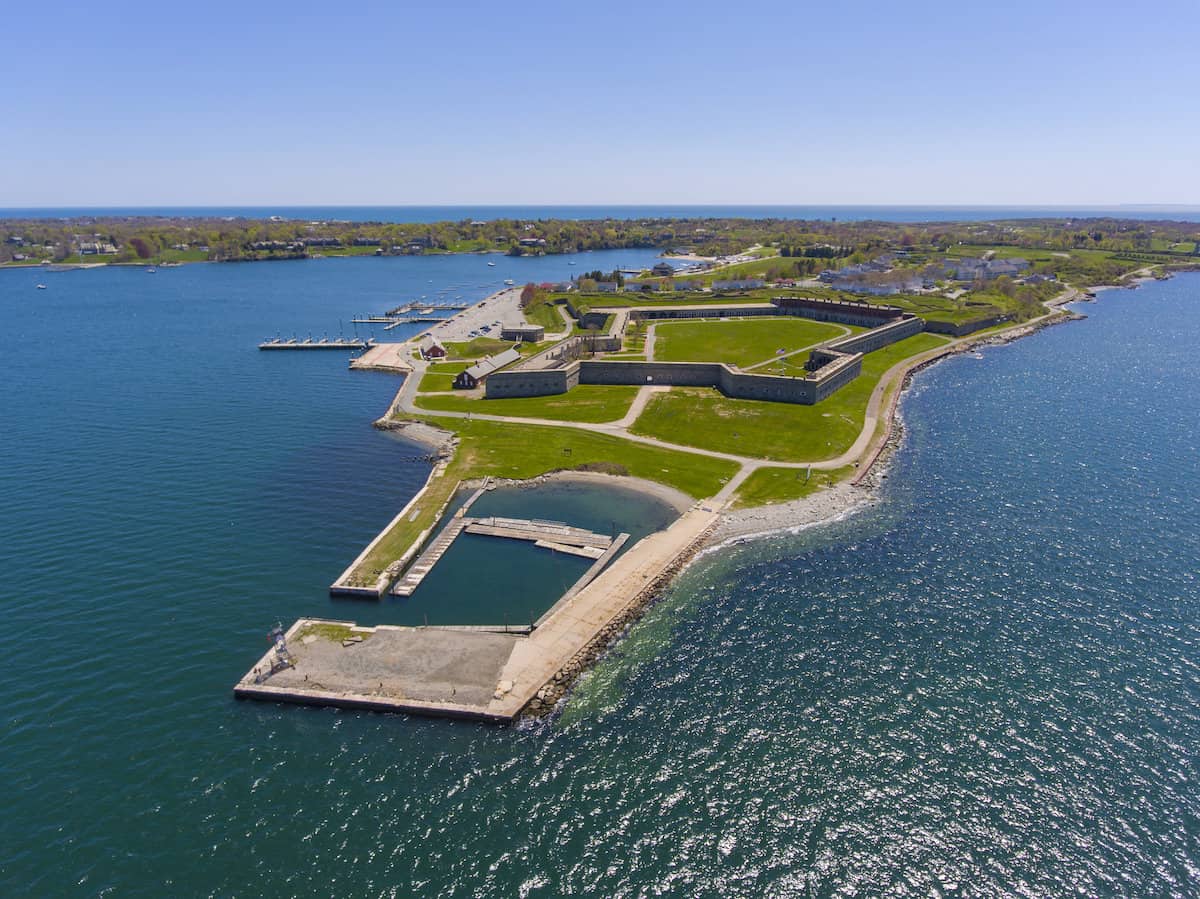
Newport – and the nearby Fort Adams State Park right on the harbor – is a legendary striper town on the East Coast.
Newport is positioned right at the entrance that baitfish and the stripers chasing them take into Narragansett Bay.
Any time you’ve got a constricted passageway to an open bay or harbor, it’s almost always going to be a point where game fish like striped bass use the limited space to corral baitfish.
In this instance, abundant rocks and boulders offer an inviting atmosphere for big stripers to push into and out of Narragansett Bay as tides fluctuate. And they’ll always be passing Newport as they come and go.
Kings Beach Fishing Area in Brenton Point State Park is a great choice for angler access.
The park is at the southernmost tip of Newport, almost necessitating that stripers round it as they head either north or south. That makes this park an ideal place to stake a claim for surfcasters.
Diamond jigs, bucktails and topwater plugs at first and last light are all popular options here.
Access: Lincoln Drive in Newport leads right into Fort Adams State Park, and if you follow the road, you will find free parking during daylight hours. Or take Ocean Avenue to Brenton Point State Park.
Sakonnet Point
To the east, a few miles from Massachusetts, Sakonnet Point is another promising point of land that intercepts the striper migration.
A small beach stretches into boulder-strewn water toward East Island, West Island and Little Cormorant Rock, which houses Sakonnet Point Lighthouse. The giant boulders and the tiny lighthouse sitting alone on an island make for an ideal and picturesque surfcasting environment.
Stripers use the rocks as cover and move in, especially in low-light situations, to position and feed on baitfish tossed around in the breaking waves.
Access: A parking lot near Sakonnet Point is reserved for residents and people launching boats in nearby Sakonnet Harbor. Street parking nearby is your best option.
Beavertail State Park

Just south of Jamestown, and across an opening into Narragansett Bay from the number-one spot on our list sits Beavertail State Park.
Stripers will push bait against the boulders, especially at first and last light.
The relatively deep water near land makes Beavertail particularly attractive for surfcasters, allowing stripers to wait in safety at a comfortable depth, ambush their prey, and return to a comfort zone, all without getting far from shore.
Working a diamond jig, bucktail or Storm shad right in the breakers can be enormously effective.
The surf at Beavertail can be enormous depending on the tide and weather, so be sure to exercise caution on the rocks.
The views from the lighthouse can be stunning in the right weather, and a lighthouse museum illustrates the location’s historical significance.
Access: During the summer, there is free parking at the lighthouse grounds, and you can check the state site for out-of-season rates and regulations.
Point Judith Lighthouse

Point Judith is a sacred name among surfcasters, right up there with Montauk and Race Point in terms of lighthouse fame.
Point Judith and the nearby designated Camp Cronin Fishing Area are among the most popular and well-known locations for shorebound surf anglers in the state and perhaps all of New England.
Point Judith extends farther south into Block Island Sound than any other point in the state. That means stripers moving north in the spring or south in the fall are more apt to hug this stretch of shoreline than most.
Because of its notoriety, it is seldom empty. And when schools of bass are pushing through, surfcasters may line the point.
The rocks at Point Judith can be dangerous and require proper footwear (Korkers boots are ideal) and caution and all times.
At low tide, you’ll have a good shot at stripers pushing bait right at the point. On the southwest corner of the point, you’ll notice a slightly indented section of the shore. That bowl is where stripers and bluefish trap schools of menhaden (bunker).
Because bunker is such a common bait here, lures like a pencil popper (which imitates a fleeing bunker) are an excellent option to start out with.
Access: Follow Rte. 108/Ocean Road south from Narragansett and you will see signs for Point Judith and the fishing area on your right-hand side.
Rocky Point State Park
Where the Providence River empties into Narragansett Bay, you’ve got Rocky Point State Park and the relatively new Rocky Point State Park fishing pier.
In the spring, when stripers are corralling schools of menhaden into harbors and bays, this area in Warwick can have tremendous action.
It’s worth noting that the river does have the potential to hold holdover stripers (fish that do not undertake the migratory journey south), so those fish are likely to be right around the river’s outlet toward the end of the fall.
Stripers will use any structural advantage that they can to entrap baitfish species that otherwise might have the entire Atlantic Ocean to escape.
Harbors like Narragansett Bay can be ideal places to find them when they’re still feeding heavily in the cool months of May and early June.
Access: Rocky Point State Park is at the intersection of Rocky Point Avenue and Palmer Avenue. Parking is available.
Watch Hill
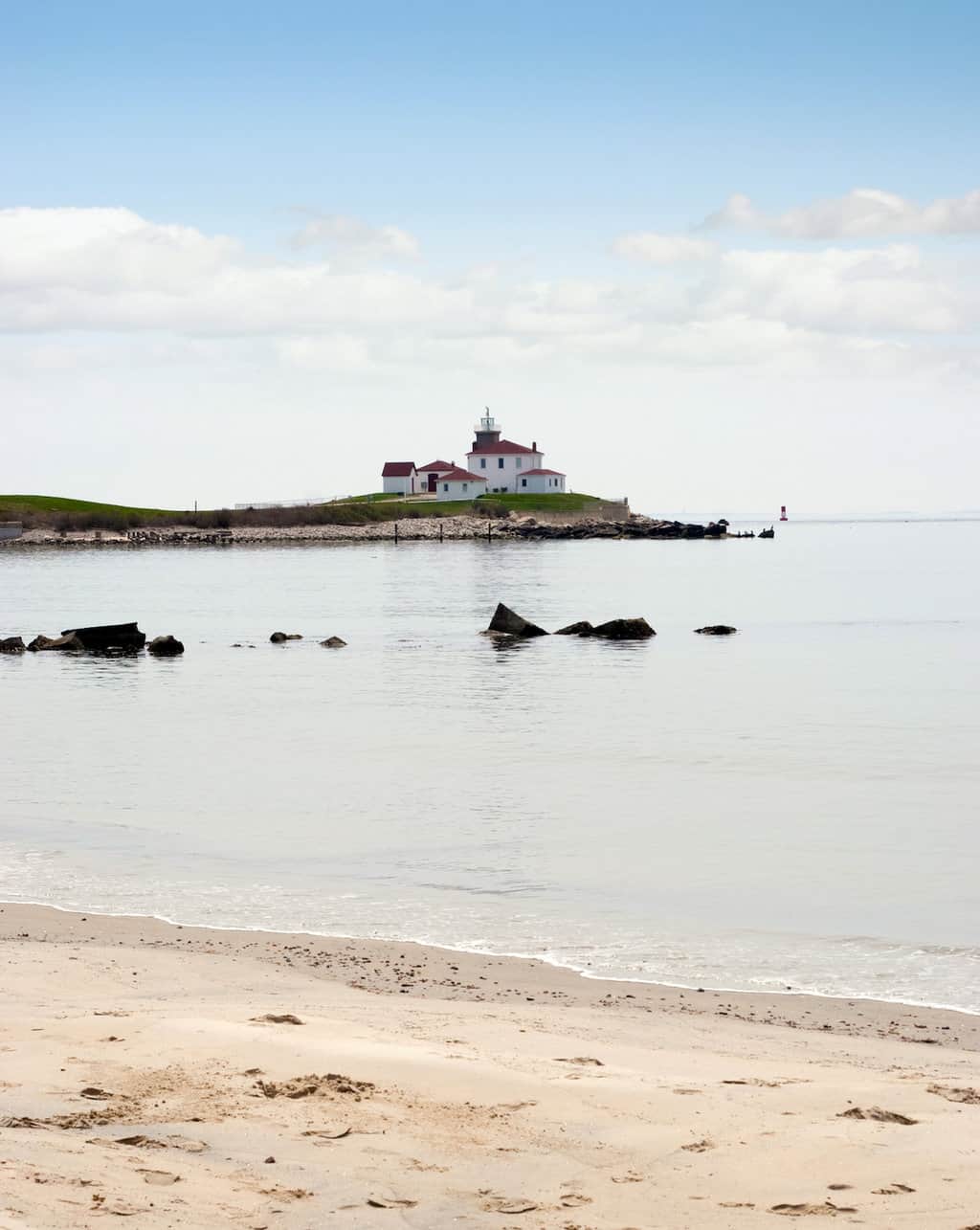
East Beach and the nearby Watch Hill Lighthouse sit right on the southwest corner of the state on a point protruding out into Block Island Sound that is a natural magnet for stripers and blues.
Watch Hill is another geographical point that juts out into and intercepts the migratory path of these fish and puts anglers on prime real estate to cast into a potential blitz.
Longer rods for farther casts are preferred here but plugs like metal-lip swimmers and darters can both be effective from the lighthouse.
An eel fished at night can be deadly, and keep in mind that mullet also are typically migrating past here in the middle to late fall.
Mullet, like adult bunker, are one of those baitfish that are so large that they’re a tough meal for a big striper to pass up. Plenty of lure companies make lifelike representations of these striped baitfish.
Your best option is to fish the incoming tide. Also, fishing at first and last light will improve your odds. A few hours after sundown can be ideal for surfcasters experienced with fishing in the dark.
Access: Parking at the lighthouse is allowed for seniors and people with disabilities. For others, street parking in Watch Hill and walking down Lighthouse Road is your best bet.
Block Island
Block Island is another patch of sand that is famous in striper-fishing circles.
This small island is only 14 miles northeast of Montauk Point, so the same schools of fish that are crashing bait on Montauk’s rocky shores in the spring and fall are hitting Block Island shortly before (or after) they reach the surfcasting capital of the world.
Not surprisingly, perhaps, Rhode Island’s state record striped bass, a 77-plus-pound behemoth, was caught here.
You can take a regular or high-speed ferry to Block Island. Once there, Snake Hole Road will lead you to Vaill Beach, which has a structure referred to as Snake Hole just off the shoreline that can hold bass in the shoulder seasons of spring and fall.
Near the end of SW Road on the (you guessed it) southwest corner of the island is Southwest Point, another popular and productive Block Island beach.
Access: 304 Great Island Road in Narragansett will bring you to the Block Island Ferry terminal.
Charlestown Breachway
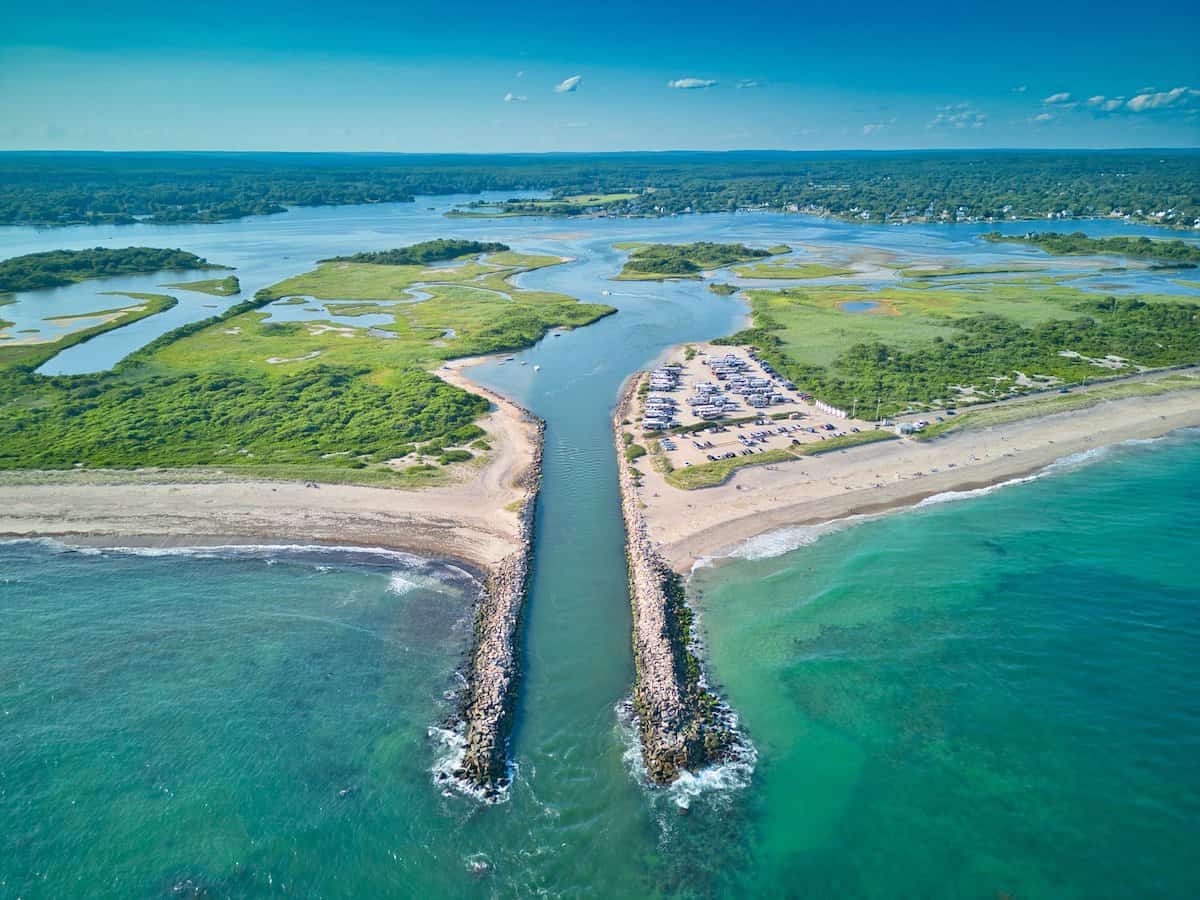
Rhode Islanders use the term “breachway” to refer to a narrow passage between the open ocean and a harbor or bay, and three of these channels are among the best striper fishing spots in Rhode Island.
It stands to reason that these passages concentrate baitfish moving back and forth between bays, harbors, salt ponds, and the open Atlantic. In so doing, they create a veritable buffet table for game fish like stripers, bluefish, false albacore and bonito.
The Charlestown Breachway connects Ninigret Pond and Tautog Cove with Block Island Sound. More to the point for anglers, it’s a popular passageway for schools of bait and the game fish that depend on them.
In the spring, saltwater ponds like Ninigret will warm the quickest and concentrate bait. In the fall, migrating fish will use salt ponds like this one to blitz on the same baitfish species as they fuel their journey south.
In either season, the breachway that connects the pond and the Sound is a strategically ideal place to stake a claim if you’re a surfcaster looking to connect with stripers.
While anglers have different approaches to breachways, the best bet is to fish them on a dropping tide. The first three hours of that dropping tide is typically the most popular.
There will be a lag between the tide chart for the beaches “out front” and the breachway itself because water takes longer to pass through the narrow channel.
So, for example, there is typically a 3-to-4-hour lag between the pond and Block Island Sound. Whereas high tide might be noon in the Sound, it would peak at around 3 p.m. in the pond.
Diving plugs are popular off the ends of the jetties because they can suspend and hold in strong currents. Bucktails and soft plastics on heavy jigheads work well in the channels.
Access: You can purchase beach parking permits at the town clerk’s office for lots on Charlestown Beach Road.
Quonochontaug Breachway
Another popular breachway fishing location for Rhody anglers is known simply as “Quonny.” This breachway connects Quonochontaug Pond to Block Island Sound.
Quonny, too, is most popularly fished on the first half of the dropping tide.
And while the jetties at these breachways will offer popular real estate at the end for anglers looking to get the first lure in front of fish coming in or leaving, don’t despair if you can’t snag your own jetty rock near the end.
Often, the “pocket” where the jetty marks a right angle with the beach can be another productive spot, with fewer anglers vying for it.
Stripers are constantly searching for something like a corner, and it’s hard to find corners in the open Atlantic. In a pocket created by a jetty and an adjacent sand beach, baitfish like menhaden have nowhere to go.
Schools of striped bass can push their prey into these pockets and eat until their heart’s content while saving the energy it would take to chase that same school down a beach.
Access: There is a parking lot for about 50 vehicles at the end of W. Beach Road in Quonochontaug. Parking is first-come, first-served.
Weekapaug Breachway
The Weekapaug Breachway connects Winnapaug Pond to Block Island Sound and is the third major Rhode Island breachway where anglers concentrate their efforts.
Keep in mind that the tide in Winnapaug Pond is going to slack between three and four hours behind the tide out front on the Sound, because that water takes time to pass through the narrow channel.
Anglers can catch striped bass both in the pond and out front, but most schooling fish will be ambushing bait on the ocean side. Because of the tidal lag, concentrate your efforts on the beginning of the dropping tide (or between three and four hours after high tide is forecast out front).
If we consider that bait in the salt ponds is dropping back to the Sound as water leaves the pond, it stands to reason that most bait will leave as the tide begins to drop, and the action will slow as you near slack tide.
Flatfish like fluke can often be caught during slack tide, but typically stripers and bluefish will use strong tidal currents to their advantage when setting up to feed.
Surfcasters comfortable with fishing from a jetty can get great real estate at the end of the jetty adjacent to the breachway.
The corners that the beach forms with the jetty on the opposite side of the channel can be a prime location for anglers who’d rather fish from the beach than the jetty.
Access: Public lots on the corner of Weekapaug Road and Atlantic Avenue are a short walk from the breachway.
Catch More Stripers in the Surf
Read our full guide to fishing for striped bass from the surf, points and channels along the East Coast.
Summary
Although Rhode Island is the smallest state, the varied structure, channels, inlets and beaches along its coastline give it more than ample options for striper anglers looking to catch these fish under different conditions, on different tides, and at different times of the year.