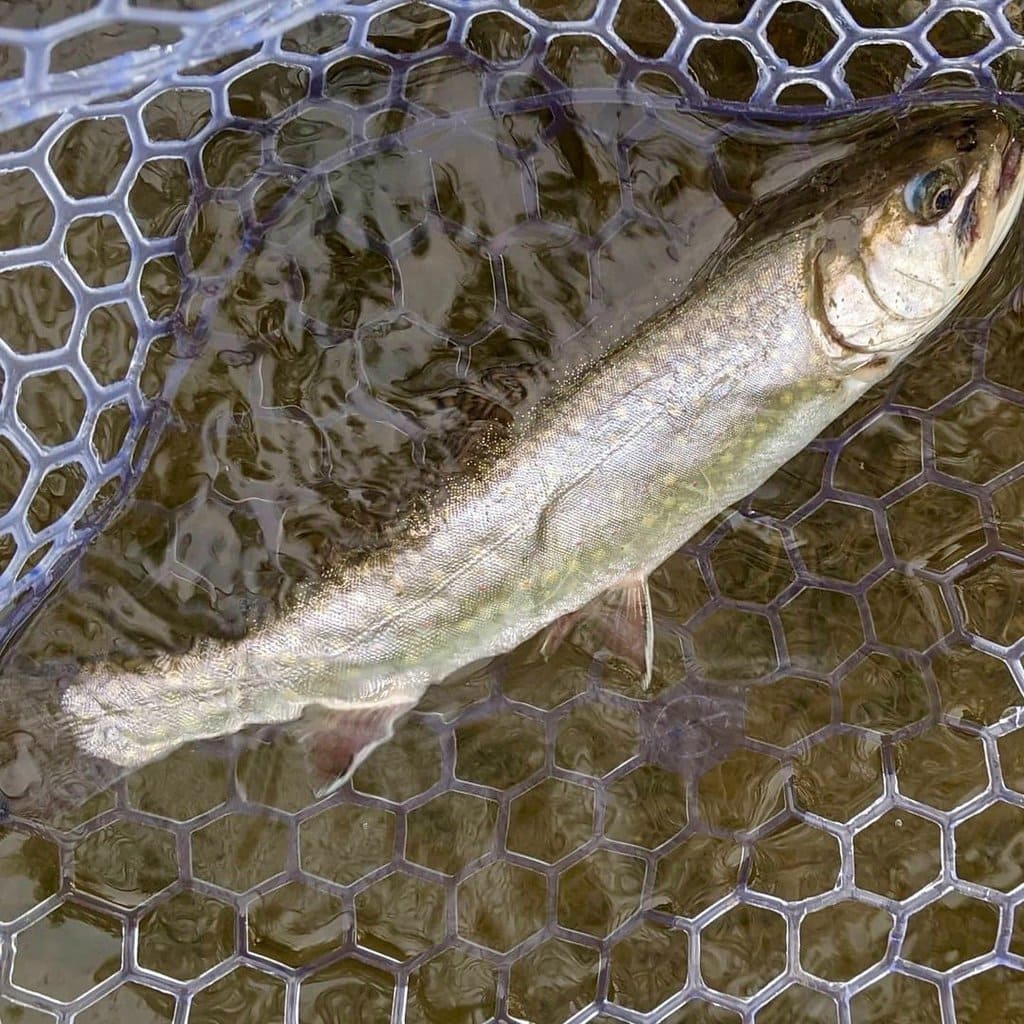
Brook trout are an angler favorite from the East Coast to the mountainous West, and from Canada to Georgia.
This article will highlight some of the top lures, flies and bait you’ll need to consistently catch brookies.
Brook Trout Lures
There are a variety of lures that can be effective for brook trout, but some stand out above the rest. The following favorites have served avid trout anglers like me well for years and are great options throughout the year.
Phoebe Wobbler
The Phoebe Wobbler is a classic trout lure that has been around since 1960.
The Phoebe, a personal favorite that I’ve used to catch brook trout all over Upstate New York, is shaped like a small baitfish.
However, that isn’t the genius of its design. The lure has a slight curvature, meaning, as its name suggests, it “wobbles” as it sinks or moves through the water column.
What sets the Phoebe apart from other spoons or spinners is that no matter what it’s doing, it always has that tempting motion. Its erratic action causes it to reflect the light in the water and catch the eye of any species that preys on small baitfish.
The 1/8th-ounce Phoebes, because they’re so light, fall the slowest through the water column and are best for small streams and shallow ponds, including several of my favorite fishing spots.
I turn to slightly heavier Phoebes to fish deeper rivers and lakes.
As a general rule, all silver or silver-and-blue spoons work best in clear water, while the gold spoon works best when the water is dirtier, such as from rain or snowmelt.
Of course, there are a variety of patterns, but silver and gold have been the most effective for me in my years of targeting brook (and also for brown trout).
Williams Nipigon Spoon
How could we neglect a spoon named after the Canadian river that produced the world-record brook trout?
These spoons come in various finishes, including genuine silver and 24K gold. With a slightly larger profile than the Phoebe, you can use them for jigging, trolling or casting.
Acouple elements make the Nipigon spoon intriguing: The trebles are bright red, and most anglers know that a flash of red can be an effective color.
They also have a false eye on the face of the spoon. Many game fish will zero in on the eye of their prey when feeding, because it helps them attack the baitfish from an angle that makes it unlikely it will escape. (This is why many fish have ‘false eyes’ on their tails, so that predators attack from the wrong end, allowing them to escape).
The combination of the bright silver and gold finish and the false eye make this a great option no matter how you fish it.
Rapala Countdown CD-9
If there’s one drawback to using spoons, it’s that you’re targeting all fish when you use them. You’re just as likely to have a 9-inch brook trout hit as you are a 9-pounder.
If you’re hoping for a larger specimen, stickbaits like the Rapala Countdown can be a great option.
The nice thing about the Countdown is that it lets you get deep. That’s where the biggest brook trout will be from the late spring through the early fall.
I’ve found that an erratic motion with fast sweeps of the rod tip will mimic a wounded baitfish swimming in spurts. That movement can elicit violent strikes.
Purple is an especially popular color for brook trout, but silver and black are also popular shades.
As you fish, take note of your depth.
In the summer especially, let the lure get down where brook trout hold in lakes before retrieving it. Countdowns can also be effective in moving water, especially targeting fish in deeper holes.
Panther Martin Spinner
Panther Martins have been an enormously popular trout lure for decades, and they’re especially effective for brook trout.
The black Panther Martin with yellow dots and a gold blade is a favorite color pattern, as is the silver-bladed Panther Martin with a yellow body.
While working at Bass Pro Shops, I’ve noticed that these colors and patterns are often sold out, a better indicator of success than just about anything.
The relatively dense lures can cast far and sink fast, making them an effective means to fish ponds or lakes when you’re trying to get down among the holding trout.
Brook Trout Trolling
Lake Clear Wabbler
Perhaps the single most popular and effective way to target big brook trout in the Northeast is by trolling spoons like the Lake Clear Wabbler.
These spoons, which come in a variety of colors, are meant to either be trolled by themselves or with a leader behind them connected to a hooked worm. The idea behind the spoon and the worm is that the Wabbler attracts the trout when it is trolled by, and the bait entices the hit.
In 2011, an angler named Dan Germain used a Wabbler and worm combination on South Lake in New York to catch a 5-pound, 8-ounce brook trout.
Germain was so taken with the fish that he packed the saddle bag of his motorcycle with ice and put it in to get it to a taxidermist.
He had already dropped the fish off and left when he discovered it could be a state record brookie. He called the taxidermist, who had yet to work on the fish, and the record was certified. (That record has since been eclipsed.)
Brook Trout Flies
Dry Flies
Stimulator
The stimulator pattern gets the attention of fish feeding on the surface, and it can be particularly effective in the early summer when warming water temperatures have these fish active and searching for meals on top.
At first and last light, drifting a stimulator pattern over pools or eddies in streams and rivers can be deadly. Use a flotant to keep the fly on top.
A yellow stimulator in a size 11 or 12 is just about perfection.
Caddis Emerger
The idea of this fly is to look like a bug just getting ready to take off from the water’s surface, an irresistible offering for a lot of brook trout. Especially in an olive color (size 12-14).
Here again, pools near faster water will be a great place to drift the emerger. Trout will hang just outside of the stream’s main current, waiting for a meal just like this.
The Adams
This popular attractor pattern has long been a brook trout favorite.
An Adams will fish most effectively from late spring through early summer and can work well in slower-moving water or in ponds or lakes, especially at first and last light.
Nymphs
Beadhead Prince Nymph
This nymph imitation fly will get down quickly and get those brook trout hanging just off the bottom, waiting for a meal to drift by.
The Prince Nymph has a lot of color variation to catch a brookie’s eye as it swings by. These can be effective patterns in the late fall, when fish are transitioning from spawning mode to winter hibernation.
Streamers
Bunny Leech
The Bunny leech is a simple but effective fly that is, in essence, a long strip of fur that can imitate a number of meals on a brook trout’s menu. It can resemble a leech, a slug or a fleeing baitfish and, if fished properly, can entice some ravenous strikes.
Streamers will be most effective in the fall when spawning brook trout aggressively protect their redds. However, streamers like the Bunny Leech can also work well when spring water temperatures warm up enough to get these fish moving and feeding.
Grey Ghost
In lakes with a population of rainbow smelt, grey ghost streamers with a flash of color can imitate these baitfish perfectly and be enormously effective.
Rainbow smelt migrate from ponds and lakes into tributaries in the spring to spawn. Your job is to find where the smelt are heading, imitate their behavior with a streamer like a Grey Ghost, and hold on.
Brook Trout Ice Lures
Williams Wabler
Wablers are a popular lure for jigging for open-water brookies, but they can be equally effective through the ice.
These spoons require constant jigging, so setting up a bait rod nearby and working a spoon while you keep an eye on it can be incredibly effective.
It’s helpful to remember, too, that lures that work through the ice will also work in open water under the right conditions.
Jig and Maggot
A small maggot hooked on an ice jig can be a recipe for brook trout success.
Secure the maggot on the hook and check it frequently to make sure it does not get stolen.
Maggots or mealworms can both be enormously popular through-the-ice day savers. I’ve seen some of the biggest trout that I’ve ever witnessed caught come on a mealworm you could fit on your fingernail.
Brook Trout Bait
Many times, anglers targeting the biggest brook trout will use bait for success.
While it can be enormously effective, choosing your bait can be crucial. When choosing shiners, try for the smallest specimens you can find, because those are the size that a brook trout can consume whole.
Brookies will still chase and pester a larger shiner, but they’ll have trouble eating it whole and likely will avoid your hook.
Here are some of the best brook trout baits:
Shiners
Shiners are typically used for specifically targeting larger brook trout. The smallest shiners you can find are ideal.
Where legal, rig the live shiner with the hook through its top and bottom lip and fish it under a float, depending on the depth of the water.
Trout Worms
Your typical bait and tackle shop will offer both earthworms and trout worms.
Trout worms, often called red worms or wigglers, are typically shorter and skinnier. These lively worms are ideal to rig on smaller hooks and make it easier for a brook trout to eat in one gulp.
Worms can be an effective addition to trolled spoons as well.
Grasshoppers
The hopper hatch can get some of the biggest trout in a stream or river feeding with reckless abandon because these are large bugs that make their presence known when they land on the water.
There are several hopper fly imitations, but you can also use a live grasshopper.
Rig a real hopper with a very small hook, and do your best to keep them alive.
Trout will notice them struggling on the surface. Some anglers will use a float to make it easier to see when a trout inhales the grasshopper.
Catch More Brook Trout
Now that you know the top lures, flies and baits for brookies, be sure to get more tactical by checking out my complete guide to brook trout fishing techniques and tips.